
In your pilot career, you maybe wondering whether skills matter more or your reputation? When you enter flight school, or any professional career, you often believe success depends purely on technical skill. It doesn’t. Skill gets you licensed while reputation builds your career.
In aviation, long-term success is built on emotional intelligence, personal growth, and professional conduct from the very first day. Your knowledge may earn you certificates, but your character determines how far you go.
This article shares key principles every aspiring pilot should understand early in their journey.
1. Understand That Everyone Is Watching, Even When They Say Nothing
In flight school, evaluation is not limited to exams.
Your instructors observe your attitude, your batchmates form opinions about your character and your future references are built silently.
Early professional reputation is shaped by:
-
Punctuality
-
Respectful communication
-
Preparedness
-
Emotional control under pressure
Treat every day as part of your professional interview. Aviation is a small industry, and impressions travel quickly.
2. Control Your Emotions Before You Become a Pilot
Aviation is emotional pressure disguised as technical work. You will experience:
-
Exam failures
-
Instructor criticism
-
Peer comparison
-
Financial stress
-
Delays in flying hours
Your reaction defines you more than the situation itself. Emotional intelligence in aviation means:
-
Responding instead of reacting
-
Listening without ego
-
Accepting correction without defensiveness
-
Managing frustration privately
A pilot who cannot regulate emotions cannot command responsibility.
Learn more at : Pilot Training Path: PPL, CPL, Frozen ATPL, ATPL
3. Separate Ego From Identity
Many young professionals confuse correction with insult.
When an instructor corrects you, it is not an attack — it is an investment in your growth.
If you respond defensively every time:
-
You slow your learning
-
You damage your professional image
Confidence is silent. Ego is loud.
The fastest learners are often the least defensive.
4. Learn the Art of Dignified Communication
Your reputation grows through how you speak. Avoid:
-
Gossip
-
Public complaints
-
Blaming systems
-
Emotional outbursts
Instead:
-
Speak respectfully, even in disagreement
-
Ask thoughtful questions
-
Clarify before assuming
-
Address conflict privately, not publicly
Dignity in communication builds long-term trust in aviation environments.
5. Choose Your Circle Carefully
In every batch, there are two types of students:
-
Those who discuss growth
-
Those who discuss people
Your environment shapes your mindset. Stay close to:
-
Serious learners
-
Disciplined individuals
-
Those who uplift standards
Distance yourself from:
-
Chronic complainers
-
Negative influences
-
Unethical shortcuts
Your circle predicts your professional trajectory.
Check : ICAO (International Civil Aviation Organization)
6. Build Internal Strength | Not External Validation
Early in your career, you may crave:
-
Instructor approval
-
Peer recognition
-
Social media validation
However, real professional growth happens quietly. Do the work even when no one is applauding. Emotional maturity includes:
-
Staying consistent without praise
-
Improving without constant supervision
-
Reflecting honestly on mistakes
Self-respect is stronger than public recognition.
7. Protect Your Name Early
In aviation, your name travels faster than you do.
If you are:
-
Arrogant
-
Unreliable
-
Emotionally unstable
-
Disrespectful
It may reach decision-makers before your CV does. But if you are:
-
Composed
-
Reliable
-
Accountable
-
Ethical
Opportunities will often follow quietly. Build a name that opens doors before you knock.
8. Handle Conflict With Class
Conflict is unavoidable in any professional setting. The real question is:
Do you escalate, or do you de-escalate?
Dignified professionals:
-
Address issues calmly
-
Avoid humiliation tactics
-
Maintain professionalism even when wronged
Emotional intelligence is most visible during disagreement. How you handle conflict reflects your leadership potential.
9. In your Pilot career, focus on Growth, not Comparison
Someone will always:
-
Fly before you
-
Score higher than you
-
Get selected before you
Comparison creates insecurity. Insecurity often leads to poor behavior. Instead:
-
Track your own progress
-
Build competence step by step
-
Measure improvement against your previous self
Quiet progress builds lasting success.
10. Build the Pilot | Not Just the License
From your first day in flight school, ask yourself:
-
Am I dependable?
-
Am I emotionally stable?
-
Can I be trusted under pressure?
-
Do I take responsibility?
Airlines hire skill. They retain character. Character is built through:
-
Emotional regulation
-
Humility
-
Accountability
-
Continuous self-improvement
Professionalism begins long before employment.
Final Message to Every Aspiring Pilot
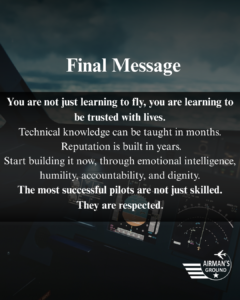
You are not just learning to fly. You are learning to be trusted with lives. Technical knowledge can be taught in months. Reputation is built over years. Start building it on day one through emotional intelligence, personal growth, and dignity in every interaction.
In the end, the most successful professionals are not just skilled, they are respected.